
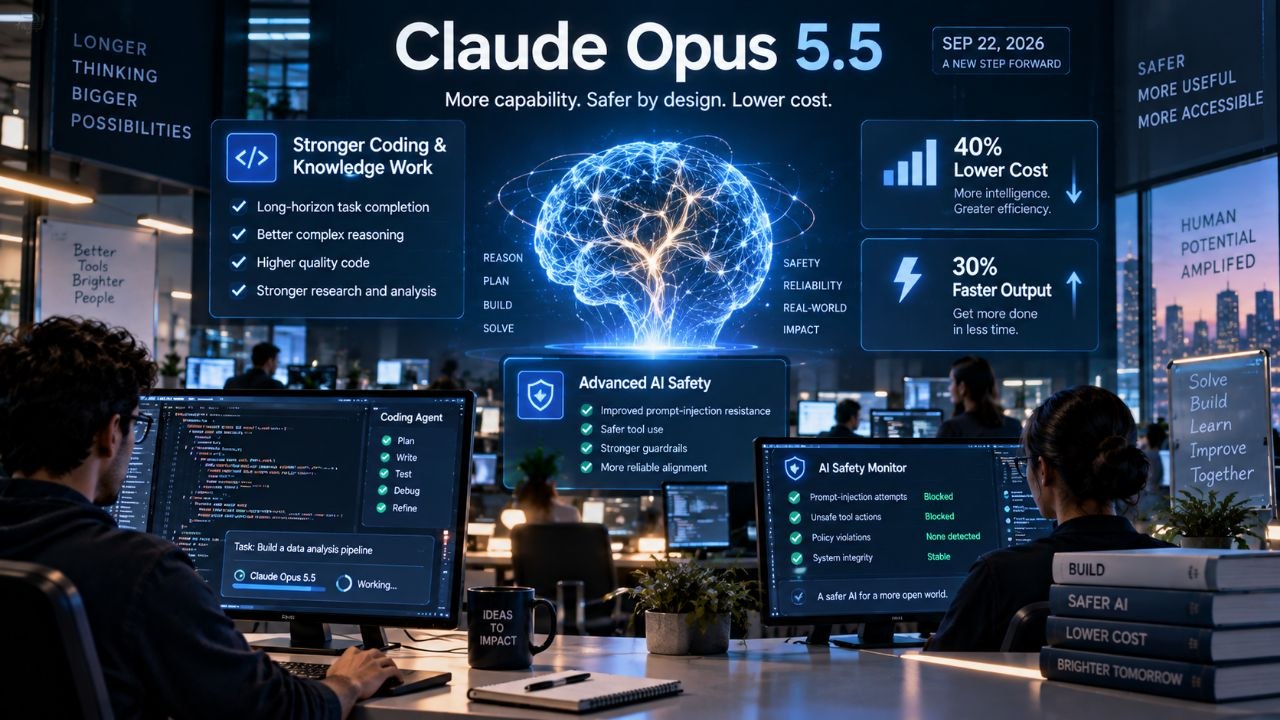
Anthropic has launched Claude Opus 5.5, the first model in its new Claude 5.5 family and its latest flagship AI system. The company says the model improves coding, long-running agentic tasks, knowledge work and safety while costing substantially less to operate than Claude Opus 5.
Released on September 22, 2026, Opus 5.5 arrives at a time when AI companies are competing not only on benchmark performance but also on the cost and reliability of running increasingly autonomous AI agents.
Anthropic says Opus 5.5 delivers performance comparable to its higher-end Claude Fable 5.1 model on most work while costing about 40% less to run than Opus 5. It also produces output more than 30% faster than its predecessor.
What Is Claude Opus 5.5?
Claude Opus 5.5 is the first release in Anthropic's new 5.5 model generation.
Anthropic positions the model toward demanding professional workloads rather than simple chatbot interactions. Its capabilities are aimed particularly at software engineering, long-running agent tasks, research, analysis and other work that requires multiple steps.
The company says Opus 5.5 can handle large codebases and sprawling engineering projects with fewer steps and less token usage than previous models.
Anthropic has also placed significant emphasis on safety testing, including external evaluation before release.
Claude Opus 5.5 Pricing
One of the most notable changes is the reduction in operating cost.
Anthropic lists the following API pricing:
$4 per million input tokens
$20 per million output tokens
$0.20 per million cache-read tokens
For comparison, Anthropic says Opus 5 previously cost $5 per million input tokens and $25 per million output tokens, while cache reads were $0.50 per million tokens.
Anthropic says its typical workloads cost around 40% less with Opus 5.5 than with Opus 5.
That distinction matters for AI agents because long-running coding and research workflows can consume enormous numbers of tokens. Lower per-token pricing can therefore affect the economics of using AI for tasks that previously required substantial human engineering time.
Claude Opus 5.5 Is Built for Long Coding Tasks
Coding is one of the areas where Anthropic says Opus 5.5 has made its biggest gains.
The company describes the model as particularly strong at large, multi-step jobs such as codebase migrations and software audits.
In one example, Anthropic says an early tester used Opus 5.5 to audit and fix a 200,000-line codebase in under three hours. Anthropic says the same work took Opus 5 more than 20 hours and required 2.5 times as many tokens.
Another example involved translating HAProxy, a widely used piece of software for distributing web traffic, from C into Rust.
Anthropic says both Opus 5.5 and Claude Fable 5.1 produced rewrites that passed nearly all of HAProxy's regression tests. Opus 5.5 completed the task in 9.5 hours compared with 12 hours for Fable 5.1 and used 51% less cost for that workload.
These examples are company-reported results, so they should be viewed as demonstrations rather than independent guarantees of performance on every software project.
Fewer Steps Could Mean Lower Agent Costs
AI coding is increasingly shifting from question-and-answer interactions toward agents that can work through an entire project.
An agent may inspect a repository, modify multiple files, run tests, diagnose failures and repeat the process without requiring a developer to provide a new prompt after every step.
That makes the number of model calls important.